
A supplier offers a carbon filter, another recommends a softener, and a third says reverse osmosis is the answer. All may be useful, but they solve different problems.
The right system begins with the source water and desired finished ice. It should protect equipment, maintain pressure, support hygiene, and deliver acceptable taste without unnecessary wastewater or maintenance.
During freezing, relatively pure water becomes ice while minerals remain in circulation or leave through the purge. Calcium and magnesium form scale; sediment blocks valves and nozzles; chlorine and organics affect taste; chloride may increase corrosion risk.
Those problems do not look the same in every machine. A tube ice machine, cube machine, flake machine, and water-cooled condenser have different flow paths, purge arrangements, and materials. Treatment should therefore be selected for the actual equipment, not copied from another project.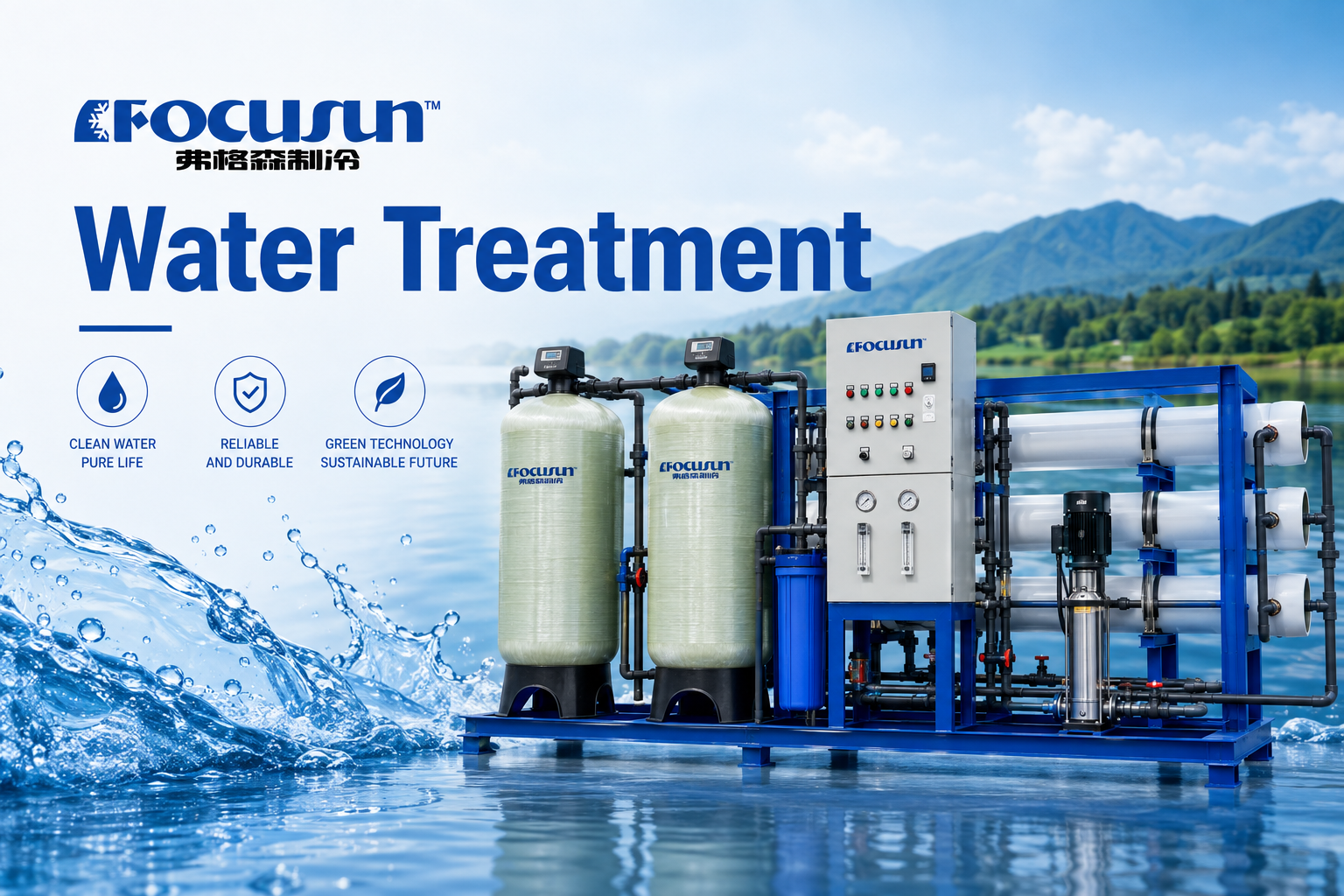
|
Treatment option |
What it mainly does |
What it does not reliably do |
Typical role |
|
Sediment filtration |
Captures sand, rust, and suspended particles |
Remove dissolved hardness or salts |
Protect valves, pumps, and downstream filters |
|
Activated carbon |
Reduces chlorine, odors, and selected organic compounds |
Remove calcium and magnesium hardness |
Improve taste and protect sensitive treatment stages |
|
Water softener |
Exchanges calcium and magnesium ions |
Remove all dissolved solids or microorganisms |
Reduce hardness-related scale |
|
Reverse osmosis |
Removes a broad share of dissolved solids |
Provide unlimited flow without storage and maintenance |
Improve consistency where mineral load is high |
|
Scale inhibition |
Interferes with mineral deposition under suitable conditions |
Correct every water chemistry or remove existing scale |
Add protection in a properly designed program |
The table explains function, not final selection. A treatment train may combine two or more stages, and potable-ice projects must use components approved for drinking-water service.
A sediment cartridge protects valves, spray holes, pumps, and downstream media from particles and rust. Its micron rating and housing must support peak flow without starving the machine.
Activated carbon reduces taste, odor, chlorine, and selected chemicals and may protect RO membranes. It does not soften hard water. Replacing carbon cartridges will not solve a hardness problem.
Focusun’s commercial cube ice machine range is used where appearance and beverage quality can matter, while its HACCP guide for tube ice production explains why water preparation, food-contact design, and sanitation must work as one system.
A softener exchanges calcium and magnesium for sodium or potassium ions. Because these hardness minerals drive many common deposits, softening can substantially reduce scale in the ice-making circuit and in water-cooled equipment.
A softener needs regenerant, periodic regeneration, drainage, hardness testing, and hygienic care. It does not remove every dissolved contaminant, and a partly open bypass can make a healthy-looking unit ineffective.
Softening is most attractive when laboratory results show hardness is the dominant problem and the site can maintain the unit correctly. It is not a substitute for purging, descaling, cleaning, or sanitizing.
Reverse osmosis pushes water through a membrane and removes a large share of dissolved minerals. It can improve consistency, reduce scale potential, and support clearer ice when source water is highly mineralized. It may also address constituents that a softener leaves behind.
RO design must account for membrane rate, inlet conditions, pretreatment, reject water, storage, pumping, sanitation, and peak demand. If the machine draws faster than the RO system can supply, production suffers despite excellent water quality.
Very low-mineral water should also be reviewed against equipment materials and manufacturer requirements. The objective is stable, suitable water—not the lowest possible TDS number.
Scale-inhibition media can reduce deposition, but performance depends on chemistry, temperature, flow, and contact time. It cannot hide severe hardness or silica problems or remove existing scale.
Water treatment must work with the machine’s purge cycle. A restricted dump valve or reduced bleed-off keeps concentrated minerals in circulation. Focusun’s guide on reducing scale inside an ice machine covers safe descaling and operating checks, while the air-cooled versus water-cooled ice machine guide explains why condenser choice changes the treatment workload.
Average daily water use is not enough. Confirm instantaneous flow, required pressure, ice production water, purge water, and—where applicable—condenser or cooling-tower water. Include pressure loss through dirty cartridges and allow access for replacement, sampling, bypass control, and drainage.
For a large industrial tube ice machine, the treatment plant may need storage and duty/standby pumps rather than a small inline housing. Treatment cost should be evaluated with water, sewer, salt, membrane, filter, labor, cleaning, downtime, and energy costs. The industrial ice machine price guide provides a broader view of the equipment surrounding a complete ice plant.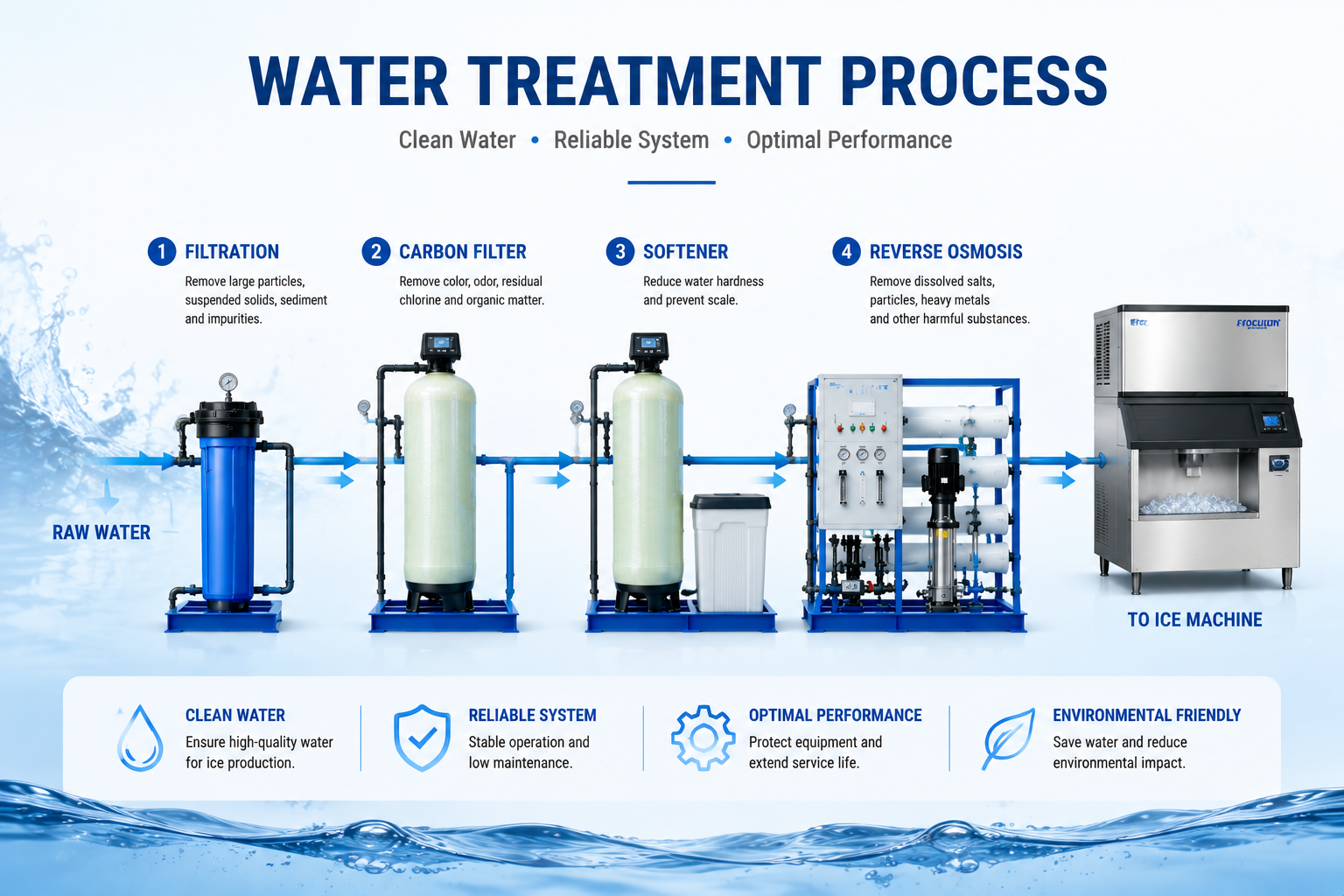
Commissioning is the beginning, not the finish. Record source and treated-water hardness, conductivity or TDS trend, pressure before and after filters, flow, filter changes, softener regeneration, RO recovery, purge operation, cycle time, ice appearance, and output. Replace consumables by measured capacity, pressure drop, or validated schedule rather than appearance alone.
If scale, taste, corrosion, or cloudy ice returns, retest both raw and treated water. Seasonal source changes, exhausted media, membrane fouling, incorrect regeneration, and bypass leakage are common explanations. To match treatment to a new plant, provide a laboratory water report, ice type, daily output, condenser design, and operating schedule through the Focusun project enquiry page.
Every commercial ice machine benefit from evaluating its water, but not every site needs the same equipment. A clean, moderately mineralized municipal supply may require sediment and carbon filtration, while hard or high-TDS water may justify softening, reverse osmosis, or scale inhibition. Treatment also depends on whether the ice is edible, the machine recirculates water, and the condenser uses water. Begin with a laboratory analysis and the manufacturer’s water requirements. Installing an elaborate system without those inputs can waste money or create low pressure and insufficient flow.
A standard sediment or carbon filter is not a hardness-removal device. When calcium and magnesium are high, the practical options are usually a correctly sized water softener, reverse osmosis, or a validated scale-inhibition program. The best choice depends on hardness, alkalinity, silica, chloride, total dissolved solids, flow rate, wastewater limits, taste expectations, and maintenance capability. Test the treated water after installation rather than assuming the equipment is working. A small filter that causes pressure loss can reduce ice output even if it improves one part of the water chemistry.
A softener is targeted and often economical when hardness is the main cause of scale. Reverse osmosis removes a broader share of dissolved minerals and may improve ice consistency, but it requires pretreatment, membrane care, reject-water handling, storage, and sufficient delivery pressure. Neither option is automatically superior. Compare the source-water report, desired ice quality, peak flow, local water cost, drainage, available space, and operator skills. In some plants, softened water feeds the RO system; in others, a softener alone provides the most practical balance.
Not reliably. Activated carbon is mainly used to reduce chlorine, odors, tastes, and selected organic compounds. Calcium and magnesium ions pass through standard carbon media, so hard water can still form scale on the evaporator, nozzles, probes, and water-cooled heat exchangers. Some commercial cartridges combine carbon with scale-inhibition media, but that is different from carbon alone and must be matched to the water and flow. Read the performance specification carefully and verify treated-water hardness or scale trend instead of relying on the word “filter” on the label.
RO often improves clarity and taste by reducing dissolved minerals and other constituents, but it cannot guarantee perfect ice. Freezing method, trapped air, water circulation, purge settings, machine cleanliness, storage, and handling also affect appearance and flavor. Some ice types are naturally opaquer than others. RO water must reach the machine at adequate flow and pressure, and the storage tank and delivery lines must remain sanitary. Treat clarity as a system outcome rather than using a low TDS reading as the only measure of success.
Replacement should follow validated capacity, pressure drop, water quality, and the cartridge manufacturer’s schedule. A filter may exhaust early when sediment load, chlorine level, or daily water use is high. Conversely, calendar replacement alone can discard usable media. Install pressure gauges where practical, record water volume, and inspect trends in taste, flow, and treated-water measurements. Filters serving edible ice also need hygienic change procedures and clean housings. Never leave a cartridge in service indefinitely simply because the outside looks clean; most exhaustion occurs inside the media.
Cost ranges widely because an inline sediment and carbon system is very different from an industrial softener or RO plant with pretreatment, storage, pumps, controls, and wastewater piping. The budget should include equipment, installation, testing, replacement cartridges, salt, membranes, sanitation, water and sewer charges, labor, and lost production during service. Compare cost per tonne of usable ice and the reduction in scale-related cleaning or downtime. A cheaper undersized system can become expensive if low pressure reduces output or exhausted media leaves the machine unprotected.
Water treatment supports safe edible ice, but it is only one control. The source water must be potable, treatment components must be approved for drinking-water use, and the machine, bin, packaging equipment, scoops, and handling area must be cleaned and sanitized. Carbon, softening, or RO does not compensate for contaminated storage or poor employee hygiene. Validate treatment performance with appropriate water testing and follow local food regulations and a HACCP-based plan. Safety depends on the complete path from incoming water to packaged or served ice.
Yes, if it is undersized, clogged, installed incorrectly, or paired with insufficient supply pressure. Ice machines need a defined flow and pressure during filling. Excessive pressure drop can lengthen cycles, trigger low-water errors, produce thin or incomplete ice, and reduce daily output. RO systems add another risk when membrane production or storage capacity cannot meet peak demand. Size housings, pipes, tanks, and pumps for instantaneous flow, not only daily gallons. Measure pressure under operation and include the expected pressure loss of a cartridge near the end of its service life.
Provide a recent laboratory water analysis, source type, seasonal variations, incoming pressure and temperature, daily and peak flow, ice type, machine capacity, purge rate, condenser design, and whether the ice is edible. Also identify available floor space, drainage, electrical supply, wastewater restrictions, target ice quality, operating hours, and maintenance skills. These details allow the supplier to select pretreatment, softening, RO, inhibition, storage, and pumping correctly. Without them, a quotation may contain suitable components but still fail as a complete operating system.
